

Talking about jobs in Spanish
Asking and answering questions about what people do for a living is one of the first things you’ll need in Spanish. There are several natural ways to ask someone about their job.
How to ask about someone’s job
These three questions use different verbs, but they’re all very common in everyday conversation:
- ¿En qué trabajas?
- ¿Cuál es tu trabajo / profesión?
- ¿A qué te dedicas?
How to answer
You can either say what your job is or say where you work, depending on the context. Most jobs in Spanish have a masculine and a feminine form, so choose the one that matches your gender. For example: Soy profesor (masculine) and Soy profesora (feminine).
- Soy + job → Soy médico / Soy médica, Soy arquitecto / Soy arquitecta
- Trabajo en un / una + place → Trabajo en un hospital, Trabajo en una escuela, Trabajo en una oficina
⚠️ Careful: unlike in English, in Spanish we don’t use un / una before the job. We say Soy médica, not Soy una médica.
✅ Tip: some jobs have the same form for men and women, such as periodista or estudiante. In these cases, the article or the context tells you the gender: el periodista / la periodista. Soy periodista works for both.
Jobs and gender: a quick guide
Here’s a simple overview of how job names change with gender in Spanish:
| Masculine | Feminine | Same form for both |
|---|---|---|
| médico | médica | periodista |
| profesor | profesora | estudiante |
| arquitecto | arquitecta | cantante |
| actor | actriz | gerente |
✅ Tip: watch out for irregular changes such as actor → actriz. Practise both the masculine and feminine forms so you sound natural when you talk about jobs in Spanish.
Let’s practise: jobs vocabulary
Activity A
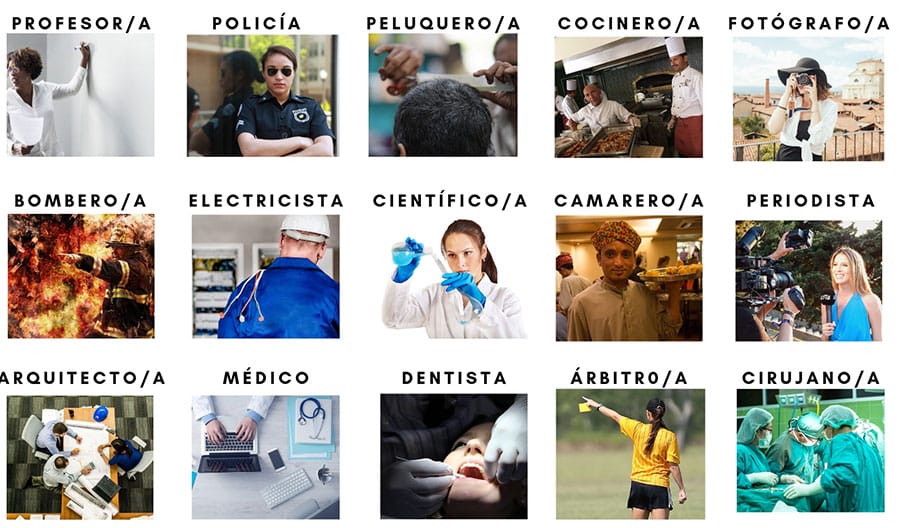
One of the jobs in the picture below is wrong. Can you spot it?
Show the answer
In Spanish you say médico for a man and médica for a woman.
Activity B
Jobs are a classic topic when you meet someone new. The dialogue below is mixed up: can you put it in the right order?
A. No, soy enfermero.
B. Hola, Ana. Yo me llamo Fred. ¿A qué te dedicas?
C. Trabajo en un hospital.
D. Hola, me llamo Ana. ¿Y tú?
E. Soy arquitecta. ¿En qué trabajas tú?
F. ¿Eres médico?
Show the answer
D, B, E, C, F, A
Hola, me llamo Ana. ¿Y tú?
Hola, Ana. Yo me llamo Fred. ¿A qué te dedicas?
Soy arquitecta. ¿En qué trabajas tú?
Trabajo en un hospital.
¿Eres médico?
No, soy enfermero.
✅ Tip: in Spanish we usually use ser with the job itself (Soy arquitecta) and trabajar en with the place (Trabajo en un hospital). Both are natural, correct ways to talk about your work.
Activity C
Write a similar dialogue in which you introduce yourself to someone new. Include a greeting, ask what they do, and say what your job is or where you work.
Use the expressions you’ve just learned: ¿En qué trabajas?, ¿A qué te dedicas?, Soy…, Trabajo en…